

How to Claim Travel Insurance
- The short answer to how to claim travel insurance is that you tell the insurer what happened, you send the documents that prove it, and the insurer pays the covered amount back to your bank account.
- Gather every document before you file, because a claim with complete papers moves fast, and a claim with missing papers waits for weeks.
- Tell the insurer as soon as you can, because many policies ask for the first notice within 20 to 30 days, and the full documents within 90 days.
- A denied claim is not the end, because you can ask for the written reason, send the missing documents, and appeal in writing.
How to Claim Travel Insurance

A cancelled trip, a hospital visit abroad or a stolen bag is bad enough on its own, and the claim that follows should not make it worse. This guide explains how to claim travel insurance in plain words, covering the documents to gather, the filing steps, what to do when a claim is delayed, how to appeal a denial, the deadlines you must not miss, and the mistakes that get claims refused, so the money you are owed comes back without a fight.
The first thing to understand is that a claim is a formal request, and the insurer pays only what the documents prove. Our pillar guide on compare hotel prices walks through the comparison process in full, and our guide on how to get hotel discounts covers the price side of the same booking, while our guide on how to get free hotel upgrades covers the room side, our guide on is it cheaper to book flight and hotel together covers bundle trips, our guide on do you need ID to check into a hotel covers the documents to carry, and our guide on how does travel insurance work explains the system itself, so read those first if you have not booked yet, then use this guide to get the money back.
How to Claim Travel Insurance The Short Answer
An insurance claim is a formal request by a policyholder to an insurance company for coverage or compensation for a covered loss or event, and the company reviews the claim and may pay out a settlement or reject the claim if it is not covered by the policy. The request starts with a phone call or an online form, and it ends with a payment to your bank account, and the middle is the documents. The insurer checks three things, because it checks that the loss is covered, that the documents prove the loss, and that the amount is right, and a claim that passes all three is paid.
The whole process has five steps, and they are simple when you take them in order. First you tell the insurer what happened, and you get a claim number. Then you gather the documents that prove what happened. Then you fill in the claim form and send the documents. Then the insurer reviews the claim, and it may ask for one more paper. Then the insurer pays the covered amount, minus the deductible, to your bank account. The review takes days or weeks, and the time depends on how complete the documents are.
The most common misunderstanding is that the insurer will find the proof for you, and it will not, because the proof is your job. The insurer never saw the hospital, the cancelled flight or the stolen bag, and the only way it knows what happened is the papers you send. Keep every receipt from the first day of the trip, because a receipt is the proof that turns a story into a claim, and a claim without receipts is a claim that will be refused.
Gather Every Document Before You File
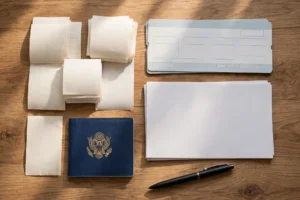
The documents are the claim, and a traveler who gathers them first files once and waits, while a traveler who files first spends weeks answering requests for more papers. Start with the policy itself, because the policy number, the coverage limits and the claim deadline are all on the policy, and the insurer will ask for the policy number first. Then gather the proof of the loss, and the proof depends on what happened.
For a medical claim, gather the hospital bill, the doctor report, the prescription and the receipts for medicine, because the insurer needs the diagnosis, the treatment and the cost. For a trip cancellation claim, gather the booking confirmation, the receipt for the prepaid cost, and the letter that proves the reason, such as a doctor note for illness or a letter from the airline for a cancelled flight. For a stolen bag, gather the police report, because most policies ask for a police report filed as soon as you can, usually within 24 hours, and a list of what was stolen with the receipts if you have them. For a delayed flight, gather the letter from the airline that states the delay, and the receipts for the hotel and meals you paid for while you waited.
Take a photo of every paper with your phone before you send anything, because a photo is a backup when the paper is lost in the post, and a claim with photos moves faster than a claim with nothing. Keep the originals until the money is in your bank account, because the insurer may ask to see an original, and a traveler who threw the original away has nothing to show. Scan or photograph the papers in good light, because a blurry photo is a paper the insurer cannot read, and an unreadable paper is a paper the insurer will ask for again.
How to File a Travel Insurance Claim Step by Step
Filing a travel insurance claim takes five steps, and the order matters, because each step gives the insurer what it needs for the next one. Step one is to tell the insurer, and you do it by phone or through the insurer app, as soon as you can after the loss. Give the policy number, say what happened, and ask for a claim number, because the claim number is the name of your claim, and every later call starts with it. Write the claim number down, and write the name of the person you spoke to, because a claim with a number and a name is a claim that can be tracked.
Step two is to fill in the claim form, and the form is on the insurer website or in the app. Fill in every box, because a blank box is a question the insurer will ask later, and a form with blank boxes waits. Describe what happened in plain words, and give the dates, the place and the amount, because the insurer reads the form before it reads the documents, and a clear form makes the review fast. Sign the form, because an unsigned form is not a form at all, and it will be sent back.
Step three is to send the documents, and you send them with the form, through the insurer website, the app or email. Send every document you gathered, because a document you hold back is a document the insurer will ask for, and each request adds days to the review. Name the files clearly, because a file called photo 1 tells the insurer nothing, and a file called hospital bill March 10 tells the insurer everything. Check that every file opens, because a file that does not open is a file that was never sent.
Step four is to answer the insurer, because the insurer may ask for one more paper, and a fast answer keeps the claim moving. Reply within a few days, because a slow reply tells the insurer the claim is not urgent, and the claim goes to the back of the queue. If the insurer asks for a paper you do not have, say so in writing, and say what you sent instead, because an honest answer is better than silence, and silence is the one thing that stops a claim.
Step five is to check the payment, because the insurer pays by bank transfer or check, and the payment arrives after the review. Check that the amount matches the claim, because the insurer subtracts the deductible first, and the payment is the covered amount minus the deductible. If the amount looks wrong, call the insurer with the claim number, and ask for the payment breakdown in writing, because a breakdown shows every number, and a number you can see is a number you can question.
What to Do When a Claim Is Delayed
A delayed claim is the most common complaint, and most delays have a simple cause, because the insurer is waiting for a paper, or the claim is sitting in a queue. The first thing to do is to call the insurer with the claim number, and ask for the status in plain words. Ask what the insurer is waiting for, and ask for a date by which the review will finish, because a date is a promise, and a promise can be checked. Write down the date and the name of the person you spoke to.
The second thing to do is to check your own papers, because the most common cause of a delay is a missing document. Check that every file you sent opens, and check that every receipt is readable, because a blurry receipt is a paper the insurer cannot use. Send any missing paper the same day, because a paper sent today moves the claim today, and a paper sent next week moves the claim next week. Ask the insurer to confirm in writing that the paper arrived, because a confirmation is proof, and proof ends the argument about whether the paper was sent.
The third thing to do is to ask for the payment breakdown, because the insurer subtracts the deductible from the covered amount, and a payment that looks small may be right. A policy with a 100 dollar deductible means you pay the first 100 dollars of every claim, and the insurer pays the rest up to the limit, so check the deductible before you call the payment wrong. If the breakdown shows a number you do not understand, ask the insurer to explain it in writing, because a written explanation is a record, and a record is what an appeal needs.
The fourth thing to do is to set a deadline of your own, because a claim that waits without a deadline waits forever. Give the insurer one more week in writing, and say that you will escalate if the claim is not decided by that date, because a written deadline is a signal, and a signal moves a claim faster than a phone call. Keep every email and every letter, because the paper trail is the proof of the delay, and the proof is what the appeal and the complaint need.
How to Appeal a Denied Travel Insurance Claim
A denied claim is not the end, because most denials can be appealed, and many appeals succeed. The first step is to ask for the written reason, because the insurer must tell you why the claim was denied, and the reason is the map for the appeal. Read the reason word by word, and check it against the policy, because a denial that quotes the wrong part of the policy is a denial that can be overturned. The most common reasons are a missing document, an excluded reason, and a deadline that was missed, and each one has a different fix.
The second step is to fix the cause, because an appeal that sends the same papers will get the same answer. If the denial says a document is missing, send the document, and send it with a short letter that says what it proves. If the denial says the reason is excluded, read the exclusions list, and check whether the exclusion really applies, because a hospital visit for a new illness is not a pre existing condition, and a cancelled flight because of illness is not a change of mind. If the denial says the deadline was missed, check the policy date, and check the date you told the insurer, because a notice given on time is a notice that counts.
The third step is to write the appeal, and the appeal is a short letter, not a long argument. State the claim number, state the reason for the denial, state what you are sending now, and ask for a review by a senior adjuster. Keep the letter to one page, because a one page letter is read, and a ten page letter is skimmed. Send the appeal by email or through the insurer website, and ask for a written confirmation that it arrived, because a confirmation is proof, and proof is what the next step needs.
The fourth step is to escalate, because an appeal that fails can go higher. Ask for a supervisor, and if the supervisor says no, file a complaint with the state insurance department, because the department regulates insurers, and a complaint from the department is a letter the insurer must answer. The complaint is free, and it takes an hour to file, and it is the last step before a lawyer, because most travelers never need a lawyer, and a complaint is enough.
Claim Deadlines and Time Limits You Must Not Miss
Deadlines decide claims, because a claim filed late can be refused even when the loss is covered. The first deadline is the notice, and many policies ask you to tell the insurer within 20 to 30 days of the loss, so tell the insurer as soon as you can, and do not wait until you come home if the loss happened on the trip. A phone call counts as notice, and a call made on the day of the loss is a call that no one can question. Write down the date and time of the call, and the name of the person you spoke to.
The second deadline is the proof, and many policies give you 90 days from the date of the loss to send the full documents. Gather the papers while the trip is fresh, because a receipt is easy to find on the day it is given, and hard to find three months later. Send the documents as soon as you have them, because a claim sent early is a claim reviewed early, and a claim sent on the last day is a claim reviewed last. If you cannot get a paper in time, tell the insurer in writing before the deadline, and say when the paper will arrive, because a warning before the deadline is better than an excuse after it.
The third deadline is the appeal, and most insurers give you 30 to 60 days from the denial letter to appeal. Read the denial letter the day it arrives, because the appeal clock starts on the date of the letter, and a letter read late is a deadline missed. Write the appeal date on a calendar, and send the appeal a week early, because a week early is safe, and a day late is refused. The fourth deadline is the payment, and the insurer pays after the review, so check your bank account every week, and call the insurer if the payment has not arrived within two weeks of the approval.
Mistakes That Get a Travel Insurance Claim Denied
The first mistake is filing late, because a claim filed after the deadline can be refused even when the loss is covered. Our guide on how to find cheap hotels walks through the full search method, and the rule is simple, because the cheapest rate is not the best rate when it leaves you with no protection at all. Tell the insurer as soon as you can, and send the documents within the time the policy gives, because a deadline is the one part of the policy that has no exceptions. The second mistake is sending incomplete documents, because a claim with missing papers waits, and a claim that waits too long is refused. Gather every paper before you file, and check that every file opens and every receipt is readable, because a blurry receipt is a paper the insurer cannot use. The third mistake is throwing away receipts, because a claim without receipts is a claim without proof, and the insurer cannot pay what it cannot see. Keep every receipt, take a photo of every paper, and keep the originals until the money is in your bank account.
The fourth mistake is not reporting a theft to the police, because most policies ask for a police report for a stolen bag, and a claim without a police report is a claim without proof. Report the theft as soon as you can, usually within 24 hours, and keep the police report number, because the number is the proof that the theft was reported. The fifth mistake is lying on the form, because a false statement can void the whole policy, and a policy that is void pays nothing, not even the part that was true. Tell the truth on every box, because the truth is the one thing the insurer cannot use against you.
The sixth mistake is the simplest, and it is the one that costs the most over time, because travelers who buy the same policy every year without reading it keep paying for coverage that no longer fits. Review the policy before every trip, because the destination, the length and the health of the traveler change, and a policy that fit last year may not fit this year. A yearly review takes an hour, and it keeps the protection matched to the trip you actually take.
FAQs
What documents do I need to claim travel insurance?
You need the policy number, the claim form, and the proof of the loss. For a medical claim, gather the hospital bill, the doctor report, the prescription and the receipts for medicine. For a trip cancellation claim, gather the booking confirmation, the receipt for the prepaid cost, and the letter that proves the reason. For a stolen bag, gather the police report and a list of what was stolen. Take a photo of every paper before you send anything.
When should I file a travel insurance claim?
Tell the insurer as soon as you can after the loss, because many policies ask for the first notice within 20 to 30 days, and the full documents within 90 days. A phone call counts as notice, so call on the day of the loss if you can, and write down the date, the time and the name of the person you spoke to. Send the documents as soon as you have them, because a claim sent early is a claim reviewed early.
Can I claim travel insurance after I come home?
Yes, most claims are filed after you come home, because the documents are gathered on the trip and sent after the trip. The first notice should still go to the insurer as soon as you can, and the full documents should reach the insurer within the time the policy gives, usually 90 days from the date of the loss. Check the deadline on your policy, because a claim filed late can be refused even when the loss is covered.
What happens if my travel insurance claim is denied?
Ask for the written reason, because the insurer must tell you why the claim was denied, and the reason is the map for the appeal. Fix the cause, send the missing documents with a short letter, and ask for a review by a senior adjuster. If the appeal fails, file a complaint with the state insurance department, because the department regulates insurers, and a complaint from the department is a letter the insurer must answer. The complaint is free.
Do I need a police report for a stolen bag claim?
Yes, most policies ask for a police report for a stolen bag, because the report is the proof that the theft happened. Report the theft as soon as you can, usually within 24 hours, and keep the police report number, because the number is the proof that the theft was reported. Without a police report, the insurer has no way to check the theft, and the claim can be refused.
How long do I have to file a travel insurance claim?
Many policies ask for the first notice within 20 to 30 days of the loss, and the full documents within 90 days, but the exact time is on your policy, so read it. The appeal deadline is usually 30 to 60 days from the denial letter, so read the denial letter the day it arrives, and send the appeal a week early. A deadline missed is a claim refused, even when the loss is covered.
Conclusion
The honest answer to how to claim travel insurance is that it is a simple trade, and the travelers who get paid are the ones who tell the insurer early, gather every paper, file once with complete documents, and appeal in writing when the answer is no. You tell the insurer what happened, you send the documents that prove it, the insurer reviews the claim, and the covered amount, minus the deductible, comes back to your bank account. The deadlines are the part to respect, because a claim filed late can be refused even when the loss is covered, and the documents are the part to keep, because a claim without proof is a claim without payment.
Start with the next trip you have planned, and run the whole method once from start to finish. Save the insurer phone number and the claim website in your phone before you leave, keep every receipt from the first day of the trip, and tell the insurer the day something goes wrong. The first claim feels complicated, and the second one feels normal, because it is normal, and a method that works once is a method that works on every trip.