

Why use trip planning tools for stress-free travel
Planning a trip should feel exciting, not exhausting. Yet 68% of travelers visit up to 10 different websites just to organize a single vacation, turning what should be a fun process into a frustrating chore. Flights on one tab, hotels on another, activities scattered across a dozen bookmarks. It adds up fast.
Trip planning tools exist to cut through that noise, giving you one place to search, compare, book, and manage everything. This guide breaks down exactly why these tools matter, how they save you real time and money, and what features to look for before your next trip.
Table of Contents
- The planning headache: Why traditional travel booking causes stress
- How trip planning tools simplify your travels
- Time and money saved: Real benefits travelers notice
- Smart features: AI, automation, and the future of planning
- Why trip planning tools aren’t just ‘nice-to-have’ anymore
- Find your next adventure with trusted travel guides
- Frequently asked questions
Key Takeaways
| Point | Details |
|---|---|
| Streamline travel planning | Trip planning tools bring all your bookings and itineraries into one organized place. |
| Save time and reduce stress | AI-powered features help you cut hours from research and decision fatigue. |
| Unlock better deals | Automated recommendations and alerts ensure you don’t miss cost-saving opportunities. |
| Stay flexible and informed | Smart tools provide real-time updates and adjust your plans as circumstances change. |
The planning headache Why traditional travel booking causes stress
Let’s look at how most travelers currently plan their trips, and where the pain points really lie.
Most people start with good intentions. They open a browser, search for flights, and within minutes they have 15 tabs open. Hotel comparison sites. Airline websites. Activity platforms. Review forums. It feels productive, but it quickly becomes overwhelming. You spend more time managing information than actually making decisions.
The numbers tell a clear story. 61% of travelers find travel apps and websites too complex to navigate efficiently, and that same research shows the majority are juggling multiple platforms just to confirm a single booking. That complexity doesn’t just waste time. It causes real stress and leads to costly mistakes.
Here’s what the typical booking process looks like for most leisure travelers:
- Searching for flights across 3 to 5 different platforms
- Separately browsing hotel sites, often without knowing which neighborhoods are best
- Manually cross-referencing reviews, prices, and availability
- Emailing or messaging travel companions with links and screenshots
- Rebuilding the entire itinerary if one booking changes
That last point is especially painful. One flight reschedule can create a cascade of problems across your entire trip. Without a central system, you’re left scrambling.
| Traditional booking | What goes wrong |
|---|---|
| Multiple websites | Inconsistent pricing and information |
| Manual itinerary building | Errors, gaps, and missed connections |
| No real-time updates | Missed alerts for delays or price drops |
| Scattered confirmations | Hard to find details when you need them |
“The average traveler spends hours researching before booking, often ending up more confused than when they started. The problem isn’t access to information. It’s too much of it with no structure.”
This is exactly the gap that trip planning tools are designed to close. You can find plenty of travel planning tips to help you get started, but the real shift happens when you move from juggling tabs to using one connected system.
How trip planning tools simplify your travels
Now that we know the pain points, let’s explore how technology can resolve them.
Trip planning tools work by pulling everything into one place. Instead of logging into five different accounts to check your bookings, you open one dashboard that shows your flights, hotel, car rental, and activities in a single view. That alone eliminates a significant amount of friction.

But the real power comes from the AI layer built into modern planning tools. 78% of travelers who use AI-powered tools end up booking based on those recommendations, which means the suggestions are genuinely useful, not just filler. The same data shows that 80% of AI users save between 1 and 3 hours per trip on research alone.
Here’s how a good trip planning tool typically works:
- Input your trip details (destination, dates, budget, travel style)
- Receive personalized suggestions for flights, hotels, and activities
- Book directly through the platform without switching tabs
- Access a live itinerary that updates automatically if anything changes
- Share the plan with travel companions in one click
The sharing feature alone is underrated. Anyone who has tried to coordinate a group trip over email knows how quickly things fall apart. A shared digital itinerary keeps everyone on the same page without a single follow-up message.
| Manual planning | With a trip planning tool |
|---|---|
| Hours of research | AI narrows options in minutes |
| Scattered bookings | Unified dashboard |
| Static spreadsheet | Live, auto-updating itinerary |
| No alerts | Real-time notifications |
Pro Tip: When using a planning tool for the first time, set your budget range and travel preferences before you start searching. The AI recommendations become significantly more accurate when the tool understands your style upfront.
If you’re planning a destination like Singapore, tools that offer curated local insights make a big difference. The Singapore guide planning resource at TravelVibeFly shows how destination-specific content pairs well with smart booking tools to give you a complete picture before you arrive.
Time and money saved Real benefits travelers notice
It’s not just about simplicity, but about measurable savings in both time and money.
Time is the most obvious win. When 80% of AI users report saving 1 to 3 hours per trip on research, that’s not a small number. For a week-long vacation, those hours represent time you could spend packing, preparing, or simply relaxing before you even board the plane.
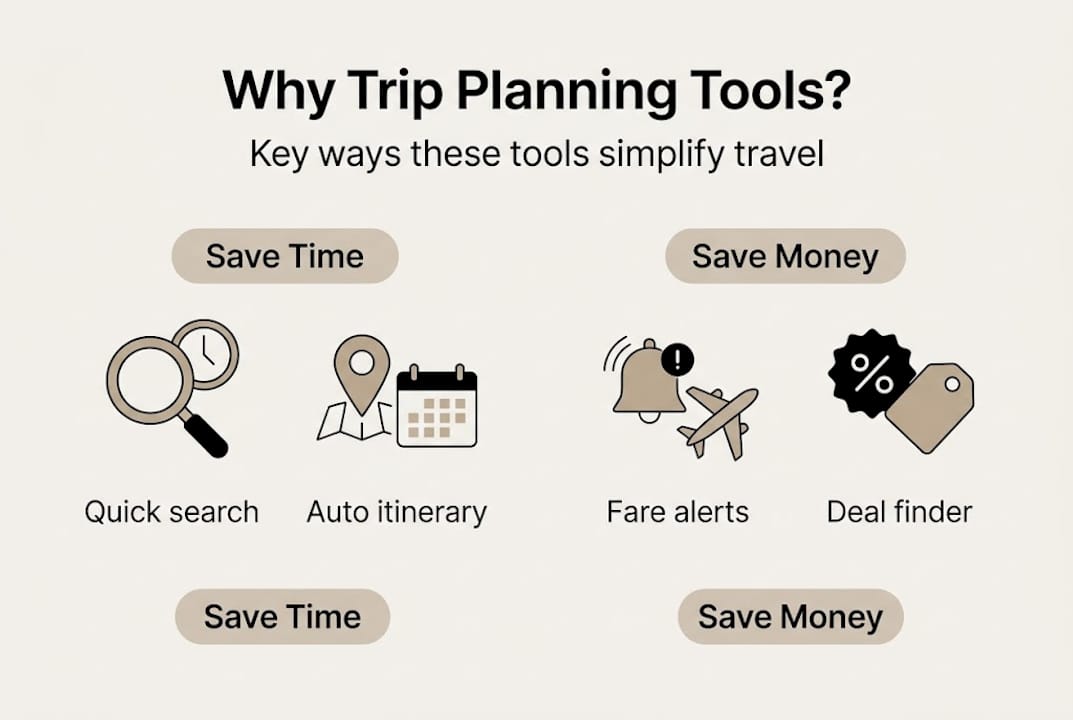
Money savings are less obvious but equally real. Trip planning tools often surface deals you wouldn’t find manually because they compare prices across multiple providers simultaneously. They also flag when prices drop, which means you don’t have to obsessively check airline sites hoping for a better fare.
Here’s a breakdown of where travelers typically save:
- Flight costs: Automated price tracking catches fare drops before they disappear
- Hotel rates: Side-by-side comparisons reveal better options at the same price point
- Activity bundles: Many tools offer package pricing that beats booking individually
- Last-minute changes: Automated rescheduling tools reduce rebooking fees
| Savings category | How tools help |
|---|---|
| Flight prices | Real-time fare alerts and comparisons |
| Accommodation | Filter by value, not just price |
| Activities | Bundle deals and curated packages |
| Time investment | Hours saved on research and coordination |
There’s also a less-talked-about benefit: fewer mistakes. When you’re manually copying confirmation numbers across platforms, errors happen. A missed digit in a booking reference or a wrong date in a hotel reservation can cost you significantly. Automated tools reduce that human error factor by keeping everything synced.
For travelers heading to cities like Berlin, where logistics can get complex with multiple neighborhoods and transit options, resources like the Berlin travel guides at TravelVibeFly pair well with planning tools to help you make smarter, faster decisions.
Smart features AI automation and the future of planning
Looking ahead, what makes these tools increasingly indispensable for the modern traveler?
AI adoption in travel is accelerating fast. Currently, 22% of travelers use AI for trip planning overall, but that number jumps to 30% for international travel, where complexity is higher and the stakes feel bigger. Among those users, 73% apply AI specifically to building and refining their itineraries.
That’s a significant shift. Itinerary planning used to mean hours with a notebook or a spreadsheet. Now it means describing your ideal trip and letting an algorithm build a logical, optimized schedule around your preferences.
The features that matter most right now include:
- Smart itinerary building: Automatically sequences activities by location and time
- Dynamic rescheduling: Adjusts plans in real time when flights are delayed
- Expense tracking: Logs spending against your budget as you go
- Crowd-based recommendations: Surfaces what travelers with similar preferences actually enjoyed
- Offline access: Keeps your itinerary available without a data connection
| Feature | Benefit to traveler |
|---|---|
| AI itinerary builder | Saves hours of manual planning |
| Dynamic rescheduling | Reduces stress during disruptions |
| Expense tracker | Keeps budget on track |
| Offline access | Reliable in remote areas |
Pro Tip: If you’re planning an international trip, look for tools that include visa requirement summaries and local emergency contacts. These details are easy to overlook but critical to have in one place.
The trajectory is clear. These tools are getting smarter every year, and the gap between travelers who use them and those who don’t is widening. You can stay current with the latest travel tech to see how new features are reshaping how people plan and experience travel.
Why trip planning tools aren’t just nice-to-have anymore
Here’s the honest take: the old way of planning travel was never actually good. Spreadsheets and email threads felt organized, but they were fragile. One change broke everything. We accepted that friction because there wasn’t a better option.
Now there is, and continuing to plan the old way isn’t a personal preference. It’s leaving real value on the table. The travelers who use smart planning tools aren’t just saving time. They’re arriving at their destinations more confident, less stressed, and with more money in their pockets.
There’s also a deeper point worth making. Travel is supposed to be about experience, not administration. Every hour spent comparing tabs is an hour not spent imagining what you’ll actually do when you get there. Tools that handle the logistics free you to focus on the part that actually matters.
The real-world travel strategies that work in 2026 are built around smart systems, not harder effort. Personalized recommendations, live updates, and automated adjustments aren’t luxury features anymore. They’re the baseline for anyone who wants to travel well without burning out before the trip even starts.
Find your next adventure with trusted travel guides
Ready to see how easy and enjoyable trip planning can be.
At TravelVibeFly, we’ve built our trip planning resources around exactly the kind of smart, streamlined experience this article describes. Whether you’re mapping out a first visit or returning to a favorite city, our destination guides give you the context and tools to plan with confidence.
Explore the Singapore vacation guide for a city that rewards smart planning, or check out our Berlin travel tools for a destination packed with neighborhoods, culture, and logistics worth knowing in advance. From idea to itinerary, TravelVibeFly helps you move faster and travel smarter.
FAQs
What types of features do trip planning tools offer?
Trip planning tools typically include AI-powered recommendations for bookings and itineraries, alongside cost tracking, real-time alerts, and shared itinerary access. The best tools combine all of these into a single dashboard so nothing falls through the cracks.
Are trip planning tools suitable for international travel?
Absolutely. In fact, 30% of international travelers already use AI planning tools, making them especially valuable when coordinating across time zones, currencies, and visa requirements.
How much time can I expect to save with these tools?
Most users report saving between 1 and 3 hours per trip, with 80% of AI users confirming that reduction in research time. That’s time you get back before the trip even begins.
Do these tools help me find better deals?
Yes. Many planning tools use algorithms to surface AI-driven deal suggestions based on your preferences, travel dates, and budget, often finding options you’d miss when searching manually across separate platforms.